ES·EN
Visibility Theater
Application of the Ritual Spaces Matrix to Port Hercule to examine how visibility, observation, mobility, access thresholds and selective participation can coexist within the same harbour landscape.
Visibility Theater · Maritime Gaze · Spectatorship · Boundary-Making · Social Sorting · Status Display · Selective Participation · Symbolic Distance · Elite Mobility
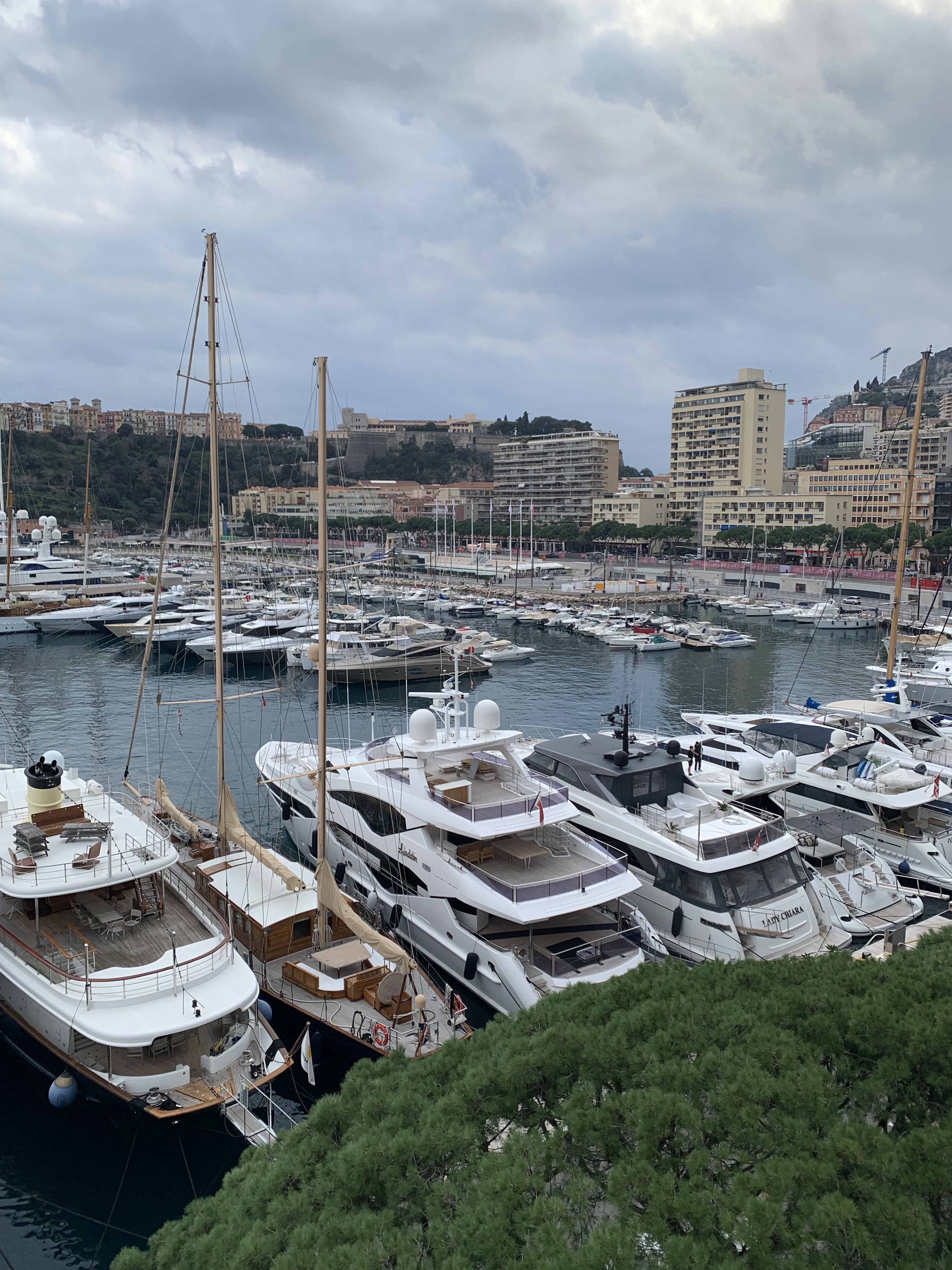
The panoramic view makes it possible to observe vessels, moorings, the waterfront, pedestrian routes and the urban fabric together.
Research use: Visibility Field · Maritime Landscape · Port-City Relations · Spatial Context
Introduction From visible space to differentiated participation
Port Hercule offers a particularly useful setting in which to apply the Ritual Spaces Matrix. Unlike spaces where a boundary is concentrated in a façade, a staircase or a doorway, the harbour offers a considerably more open visual field: vessels, quays, pontoons and some port activities can be observed from nearby routes.
This visual openness does not, however, make observing, approaching, accessing and participatingequivalent. The case is analytically relevant precisely because these positions can be examined as separate dimensions.
≠ ACCESS ≠ USE ≠ OWNERSHIP
The concept of Visibility Theater is used here to describe a configuration in which certain signs and objects associated with luxury remain widely exposed to public view, while opportunities for participation continue to be regulated by physical, functional or social boundaries.
01 · Analytical Instrument Ritual Spaces Matrix
The Ritual Spaces Matrix operates as an instrument for coding scenes. Its unit of analysis is not necessarily an entire building, neighbourhood or itinerary, but a particular spatial configuration in which an action acquires significance through its degree of visibility and social function.
The original instrument isolates four variables:
| Variable | Operational Question | Function |
|---|---|---|
| Space | Where does the scene become legible? | Identifies the spatial setting and its operational threshold. |
| Ritual | Which dominant action structures the scene? | Codes recurring actions of access, waiting, observation or movement. |
| Visibility | To what extent is the scene exposed to public view? | Low · Medium · High. |
| Function | Which social effect structures the configuration? | Sorting · Boundary-Making · Legitimation · Status Display. |
When the space, dominant action, visibility or function changes substantially, a new scene is coded.
The matrix prevents an entire sequence from being turned into a single interpretative narrative. More detailed contextual information remains in the field note; the matrix retains only the basic comparative structure.
02 · Coding Rules How observation is transformed into data
| Scene | One row represents one observable scene. |
| Space | The specific operational space is coded, rather than merely the name of the wider district. |
| Ritual | The dominant action structuring access, movement or attention is recorded. |
| Visibility | Visibility is coded exclusively as Low, Medium or High, according to observable exposure to public view. |
| Function | The dominant social effect of the configuration is identified without treating individual motivations as observed facts. |
03 · Case Study Why Port Hercule?
The significance of Port Hercule lies in its combination of high visual availability and differentiated participation. Yachts and superyachts form part of a landscape visible from different positions along the waterfront and its adjacent routes.
Depending on the sector, visitors may walk, pause, observe and take photographs without those actions automatically granting access to a pontoon or vessel.
| Visible condition | Yachts and parts of the port infrastructure remain widely visible. |
| Public movement | Certain nearby routes permit pedestrian movement and observation. |
| Physical differentiation | Quays, access points, pontoons and vessels form functionally distinct areas. |
| Selective participation | The ability to observe does not amount to the ability to board or use a vessel. |
| Visual differentiation | Scale, position, design and observable activity create differences within the maritime landscape itself. |
04 · Research Question Visibility and participation
The question shifts attention away from the mere presence of luxury goods towards the relationship between visual field, spatial proximity, threshold and effective participation.
05 · Scene Definition Delimiting the field of observation
The case focuses on Port Hercule and the relationships between the harbour basin, pedestrian routes, quays, berthing areas, pontoons, vessels and the vantage points from which these elements enter the visual field.
The territorial unit helps organise observations, but coding takes place at smaller spatial scales. A scene recorded along the waterfront promenade is not simply coded as “Port Hercule”: the operational space in which the action becomes observable is identified.
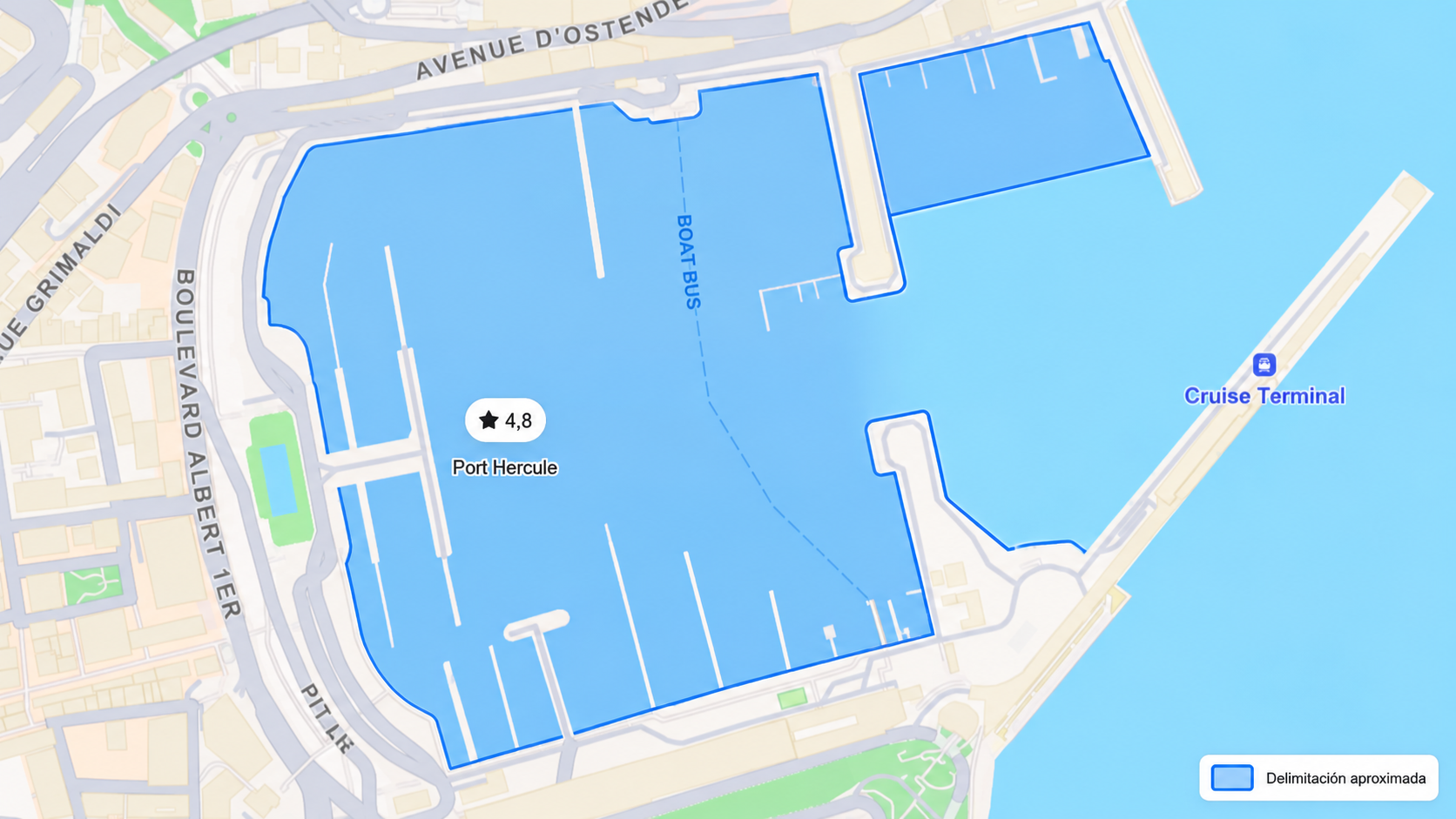
Delimitation used to organise fieldwork. It does not represent an official administrative, port or institutional boundary.
06 · Spatial Sequence From approach to participation
The configuration can be represented as a progressively differentiated spatial sequence. Each transition changes the relationship between the observer, the visible object and the possibility of participation.
↓
PUBLIC WATERFRONT
↓
QUAYSIDE PROMENADE
↓
ACCESS POINT
↓
PONTOON
↓
YACHT
The sequence does not imply that everyone passes through all its stages. Its analytical significance lies precisely in the fact that visual continuity can coexist with functional discontinuity.
An element remaining visible during approach does not mean that the boundaries regulating access to or use of it have disappeared.
07 · Ritual Spaces Matrix Applied Breaking the case down into scenes
The table retains the four variables of the original instrument. Subsequent interpretative notes do not alter the basic coding.
| Space | Ritual | Visibility | Function |
|---|---|---|---|
| Port Hercule basin / panoramic viewpoint | Observing | High | Status Display |
| Quayside promenade | Walking / photographing | High | Legitimation |
| Yacht berth | Mooring / presence | High | Status Display |
| Pontoon access point | Entry / non-entry | Medium | Sorting |
| Pontoon | Access / circulation | Medium | Boundary-Making |
| Yacht deck | On-board presence | Medium | Boundary-Making |
| Luxury yacht arrival | Docking / disembarking | High | Status Display |
| Yacht Club / adjacent frontage | Institutional presence | Medium | Legitimation |
These assignments represent an analytical coding of the case. Differences between individual scenes must be retained in the field notes rather than converted into a false degree of decimal precision.
08 · Coding Profile Analytical profile of the case
|
Spatial Coding
Primary SpacePort Hercule visibility field Secondary Spaces Quayside Promenade · Yacht Berths · Pontoon Access · Yacht Decks · Yacht Club Frontage |
Ritual Coding
Primary RitualObservation / Visual Circulation Secondary Rituals Walking · Photographing · Waiting · Entering · Boarding · Disembarking · Servicing |
|
Visibility
Dominant LevelHigh Visibility decreases or becomes more selective as one moves from the panoramic visual field towards spaces that are more functionally restricted. |
Social Function
Status DisplayBoundary-Making Sorting Legitimation |
09 · Visibility Theater Luxury as a publicly observable presence
At Port Hercule, spatial differentiation does not primarily depend on concealing the object. Much of the harbour’s visual impact derives precisely from the fact that vessels enter the urban visual field.
From Bourdieu’s (1984) perspective, certain goods can acquire value not only through their material utility but also through their capacity to operate as socially recognisable signs of distinction. Yachts can be examined here in that symbolic dimension without automatically assigning a social position to those who observe them.
Thurlow and Jaworski (2012) offer an additional perspective on elite mobilities and on the semiotic landscapes of privilege. The mobile object—the yacht—can simultaneously serve as a means of transport, a private space and a highly visible element of the landscape.
A configuration in which objects, bodies or practices associated with status remain visible to the public, while the capacity to gain access or participate is distributed unevenly.
10 · Maritime Gaze Looking, selecting and comparing
Urry and Larsen (2011) show that tourist experience is deeply connected to socially organised ways of looking. Applied cautiously to the harbour, this perspective allows us to examine which elements attract attention, from which positions they are observed and how they become part of photographic practices.
The panoramic view of Port Hercule allows numerous vessels to be seen within a single visual field. Scale, shape, position, name, flag and the presence of crew may become elements available for visual comparison.
The research does not assume that all observers interpret these elements in the same way. The concept of Maritime Gaze describes an observable relationship between position, attention and the maritime landscape, rather than a universal psychological motivation.
11 · Boundary-Making The quay as an interface of differentiation
Lamont and Molnár (2002) provide a framework for distinguishing between symbolic and social boundaries. At Port Hercule, this distinction is useful because separation can have both a material and an interpretative dimension.
A public route may place an observer relatively close to certain vessels, but the transition from the promenade to a port access point, from there to a pontoon, and finally to a vessel introduces successive functional distinctions.
| Boundary Layer | Observable Expression | Analytical Reading |
|---|---|---|
| Physical | Water, edges, gates, gangways and pontoons. | Material differentiation |
| Functional | Areas designated for movement, mooring, work or access. | Role differentiation |
| Access | Passage available to some people but not observably open to everyone. | Selective participation |
| Symbolic | Difference between public viewing and private use. | Symbolic distance |
A reduction in physical distance from a vessel does not imply that the functional boundaries organising its use have disappeared.
12 · Analytical Positions Different relationships with the same space
The original case distinguished between different types of users. This reformulation considers analytical positions within the scene rather than identities that can automatically be attributed to someone on the basis of appearance.
| Public Observer | A person observed looking or moving along a public waterfront route. |
| Photographic Observer | A person who stops or uses a device to record a vessel or the surrounding landscape. |
| Authorised Entrant | A person whose entry into a differentiated space can be observed, without inferring the reason for that authorisation. |
| Crew / Service Worker | A professional role, but only when it can be identified from sufficient functional context. |
| On-board Participant | A person observed on board; ownership, wealth or contractual relationship cannot be inferred without additional information. |
13 · Spectatorship Observing without boarding
MacCannell (1973) highlighted the importance of the spatial organisation of tourist experiences, while Urry and Larsen (2011) identify the tourist gaze as a central dimension of tourism practice.
At Port Hercule, some observable interaction with the maritime landscape can take place without boarding a vessel: walking by the harbour, stopping, looking or taking a photograph are ways of engaging with the space that differ from using it.
Not boarding must not automatically be interpreted as frustration, aspiration or a subjectively experienced form of exclusion. What can be documented is the simultaneous existence of visual participation and restricted functional participation.
↓
OBSERVING / PHOTOGRAPHING
↓
VISUAL PARTICIPATION
≠
FUNCTIONAL PARTICIPATION
14 · Elite Mobility Vessels, movement and work
A yacht is not merely a stationary object to be viewed. Spence (2014a, 2014b) highlights the relationships between elite mobility, crew, sea, vessel and shore in research on superyachts.
This perspective enables us to distinguish different forms of mobility that can coexist in the same harbour space: recreational mobility, professional mobility, service operations, boarding, disembarkation, maintenance and remaining on board.
The visible coexistence of these practices does not make their participants equivalent. The matrix records actions without attributing a social position to each person unless it has been independently established.
15 · Integrated Interpretation How the visibility theatre operates
↓
PUBLIC OBSERVATION
↓
VISUAL PROXIMITY
↓
SPATIAL THRESHOLD
↓
SELECTIVE ACCESS
↓
DIFFERENTIATED PARTICIPATION
The conceptual contribution of the case is not to claim that the harbour is simply “open” or “closed”. Port Hercule shows that these properties can coexist along different dimensions.
A space may display high visual openness and, simultaneously, differentiated functional access. This separation between visibility and participation is central to the concept of Visibility Theater.
16 · Model Contribution What Port Hercule contributes to the Ritual Spaces Matrix
| Space | Distinguishes between the overall harbour setting, the promenade, access points, pontoons and vessels. |
| Ritual | Makes different actions visible: walking, looking, photographing, entering, boarding, disembarking or working. |
| Visibility | Shows that visual exposure can remain high even as opportunities for participation decrease. |
| Function | Distinguishes between Status Display, Legitimation, Sorting and Boundary-Making according to the specific scene. |
The case also confirms the value of not coding “Port Hercule” as a single scene. The same territorial space contains different social configurations depending on the threshold, action and exposure under observation.
17 · Field Coding Minimum record for new observations
| Field | Record |
|---|---|
| Scene ID | Unique scene identifier. |
| Space | Specific operational space. |
| Ritual | Dominant action. |
| Visibility | Low · Medium · High. |
| Function | Sorting · Boundary-Making · Legitimation · Status Display. |
| Boundary Type | Physical · Functional · Symbolic · Performative. |
| Observed Action | Factual description of the recorded action. |
| Field Note | Context, exceptions and interpretation kept separate from the main coding. |
18 · Visual Evidence What the fieldwork archive should document
|
Panoramic Visibility Overall harbour configuration and concentration of vessels. |
|
Public–Private Interface Relationship between public routes, access points and berthing areas. |
|
Observation Practices Walking, stopping, looking or photographing, when these actions are directly observable. |
|
Access Thresholds Gates, pontoons, gangways or other transitions between functional areas. |
|
Operational Mobility Boarding, disembarkation, maintenance, crew and other functional actions when identifiable. |
|
Visual Proximity Changes in distance and position in relation to vessels and berthing areas. |
19 · Interpretive Limits What the evidence cannot establish
Proximity ≠ participation.
Observation ≠ aspiration.
Photography ≠ desire for ownership.
On-board presence ≠ demonstrated ownership.
Visible pedestrian ≠ demonstrated tourist status.
Visible worker ≠ known employment relationship.
Luxury object ≠ demonstrated social identity of the observer.
Symbolic interpretation ≠ individual subjective meaning.
Visual selection ≠ statistical representation.
The evidence can document position, movement, visibility, approach, observable access and spatial relationships. Motivations, identities, ownership and subjective meanings require additional evidence.
Why Port Hercule matters
Port Hercule provides a setting in which the public visibility of luxury does not require spatial differentiation to disappear. The harbour can be traversed and observed while different forms of access, work and use remain organised through functional thresholds.
This makes the case an important extension of the Ritual Spaces Matrix: spatial exclusivity need not operate through concealment. It can also occur within a highly visible setting.
The central contribution of the case can be summarised as an analytical distinction between seeing, approaching, accessing and participating.
≠
ACCESSIBLE · USABLE · OWNED
21 · Research Provenance Fieldwork and visual archive
The empirical development of this case draws on visual fieldwork conducted in Monaco between 2017 and 2026 and on materials held in the Monaco Visual Fieldwork Archive (MVFA).
Photographs and video are used to document spatial configurations, trajectories, proximity, visual fields, access points and observable relationships between the waterfront and maritime infrastructure.
The selected visual material provides contextualised evidence, not a statistically representative sample of all activities, users or situations at Port Hercule.
Visual Fieldwork · 2017–2026
Photography & Video Fieldwork · © Xavier Reinaldo-Virgili
22 · Documentation Traceability and repository
Ritual Spaces Matrix
Conceptual model and coding rules →
MVFA — Broader Visual Fieldwork Collection: Scope and Documentation
Archive documentation →
Monaco Research Observatory · OSF
Public repository →
23 · Bibliographic References References · APA 7
Bourdieu, P. (1984). Distinction: A social critique of the judgement of taste (R. Nice, Trans.). Harvard University Press. (Original work published 1979).
Lamont, M., & Molnár, V. (2002). The study of boundaries in the social sciences. Annual Review of Sociology, 28, 167–195. https://doi.org/10.1146/annurev.soc.28.110601.141107
MacCannell, D. (1973). Staged authenticity: Arrangements of social space in tourist settings. American Journal of Sociology, 79(3), 589–603. https://doi.org/10.1086/225585
Spence, E. (2014a). Unraveling the politics of super-rich mobility: A study of crew and guest on board luxury yachts. Mobilities, 9(3), 401–413. https://doi.org/10.1080/17450101.2014.946772
Spence, E. (2014b). Towards a more-than-sea geography: Exploring the relational geographies of superrich mobility between sea, superyacht and shore in the Côte d’Azur. Area, 46(2), 203–209. https://doi.org/10.1111/area.12101
Thurlow, C., & Jaworski, A. (2012). Elite mobilities: The semiotic landscapes of luxury and privilege. Social Semiotics, 22(5), 487–516. https://doi.org/10.1080/10350330.2012.721592
Urry, J., & Larsen, J. (2011). The tourist gaze 3.0. SAGE Publications. https://doi.org/10.4135/9781446251904
The paradox of accessible visibility
Port Hercule shows that social and spatial separation need not involve concealing what is differentiated. On the contrary, certain forms of luxury may derive part of their presence precisely from their high visibility.
The waterfront brings the observer visually closer to vessels, while successive spatial transitions distinguish the promenade, access point, pontoon and private area of the yacht.
The Ritual Spaces Matrix makes it possible to disentangle this apparent contradiction: the same landscape can combine High Visibility, Status Display, Boundary-Making and Selective Participation without reducing them to a single experience.
→
VISIBILITY THEATER

